Is the Amazon peeler market still viable? I ran 8 dimensions of data with the Amazon Market Deep-Dive — here's the verdict
Every week someone asks me: "Peelers — a kitchen gadget — surely OXO killed that market ages ago? Is there still a way in?" I used to answer from gut instinct built on the factory side — but beginners have no instinct, so that answer is useless.
This post demonstrates: judging "is the Amazon peeler market still viable" from 8 dimensions of real data, not guesswork. Run it once with me and you'll be able to size up any category with the same method.
What problem does this step actually solve
"Is the market viable" is too vague to answer directly. You have to break it into 8 concrete questions, each answered with real data:
Market size
Is the pie big enough to bother?
Competition
Can you break into the first pages?
Seasonality
Year-round or peak-only?
Profit room
What's left after costs?
Entry barrier
Beginner-friendly or heavy investment?
Marketing cost
Is ad CPC high?
Blue-ocean chances
Any overlooked niches?
User pain points
The biggest flaw in existing products?
Why I stopped guessing the market from BSR lists
In my early factory days taking export orders, I judged "does this sell" by manually scrolling BSR lists, eyeballing a few top sellers' monthly sales, and estimating. Later, running my own Amazon business, I hit countless pits — misjudged market size, ignored seasonality, underestimated ad costs…
❌ Estimating the market from BSR by hand
· Only a few top sellers — sample too small
· Monthly sales back-calculated from BSR, huge error
· Can't see seasonality (needs historical trend)
· Can't get ad CPC, Top5 share data at all
· Gut-feel conclusions with no quantified standard
✅ Using EasyClaw's "Amazon Market Deep-Dive"
· Connects to the official Jungle Scout API — real data
· 8-dimension quantified analysis, each with a standard
· Auto-computes CV (seasonality coefficient)
· Outputs a complete final_report.md
· Plus ~50 product recommendations + B2B suppliers
· Total time ~20 turns, 10-15 minutes
Why I use EasyClaw instead of the Jungle Scout web app
Good question — the "Amazon Market Deep-Dive" uses Jungle Scout's official API data anyway, so why not just subscribe to the JS web app?
🌐 Jungle Scout web app
Hands you a pile of metrics and charts
→ the rest ("how to interpret + decide") is on you
A beginner's pain:
· Sees "Top5 share 40%" but doesn't know if that's high or low
· Seasonality CV 0.18 — no idea what it means
· 8 dimensions of data jumbled together, no clear conclusion
→ However complete the data, a beginner can't use it
🤖 EasyClaw = "skill gets data + 8-dim standards + report"
The "Amazon Market Deep-Dive" has quantified standards built in:
· Search volume >10K big, 5K-10K mid, <5K small
· Top5 share <40% low, 40-60% mid, >60% high
· CV ≤0.5 non-seasonal, >0.5 seasonal
→ After a run it tells you directly "this dimension is good/mid/bad"
→ integrates 8 dimensions into one final_report.md
→ plus 50 product recs and B2B suppliers
It's a "decision tool" a beginner can use directly, not just a data tool.
Here's how I had EasyClaw run this pipeline
The "Amazon Market Deep-Dive" is a composite skill — not a single action, but a pipeline: call APIs → compute metrics → 8-dim analysis → recommend products → find suppliers → output report. Two steps:
📦 "Amazon Market Deep-Dive"
What it really does: calls 4 official Jungle Scout APIs (keywords_by_keyword / historical_search_volume / product_database / share_of_voice), processes the data through an 8-dim framework, and produces a complete final_report.md + ~50 product recommendations CSV + 1688 B2B suppliers. Bilingual.
After installing, configure your Jungle Scout API key in EasyClaw (get it from the junglescout.com dashboard). That's the skill's only prerequisite.
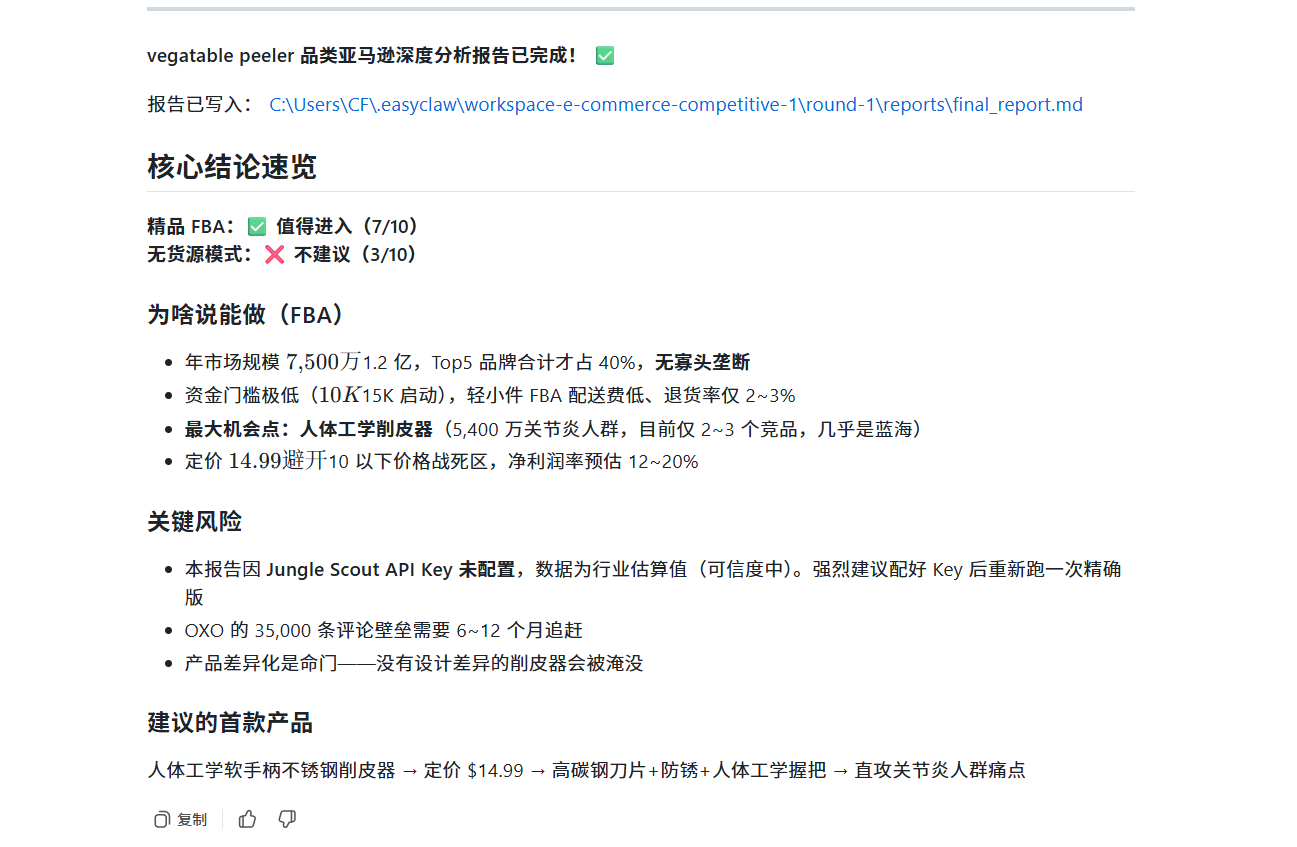
EasyClaw auto-invokes the skill and starts running the pipeline. It takes ~20 turns, asking a few clarifying questions along the way (whether to break out sub-niches, whether to include B2B suppliers, etc.).
When the pipeline finishes, the skill outputs a final_report.md
The "Amazon Market Deep-Dive" is strongest here: it doesn't just give data, it produces a structured research report. Below is a key excerpt after it ran the peeler category:
# Amazon US Peeler Market Research Report
Category: Vegetable Peeler (Kitchen > Peelers)
Price range: $10-20
Data date: 2026-06-23, industry estimate (API not configured, confidence ★★★☆☆)
1. Market Size
- Core keyword monthly search:
vegetable peeler 49.5K/potato peeler 1.6K/stainless steel peeler 880 - Long-tail aggregate monthly search: ~
195K - Amazon-channel yearly market: ~
$75M - 120M
2. Competition
- Top5 market share:
40%(OXO/Kuhn Rikon lead but no monopoly) - Top listing review barrier:
OXO ~35,000 - General-style competition intensity:
85/100
3. Seasonality
- Trailing 12-month weekly search CV:
~0.15-0.20 - Year-round demand:
stable (daily kitchen essential)
… the report also covers 4. Profit / 5. Entry barrier / 6. Marketing / 7. Blue-ocean chances / 8. Pain points — 8 dims total + overall conclusion + 50-product recommendation table + B2B supplier list
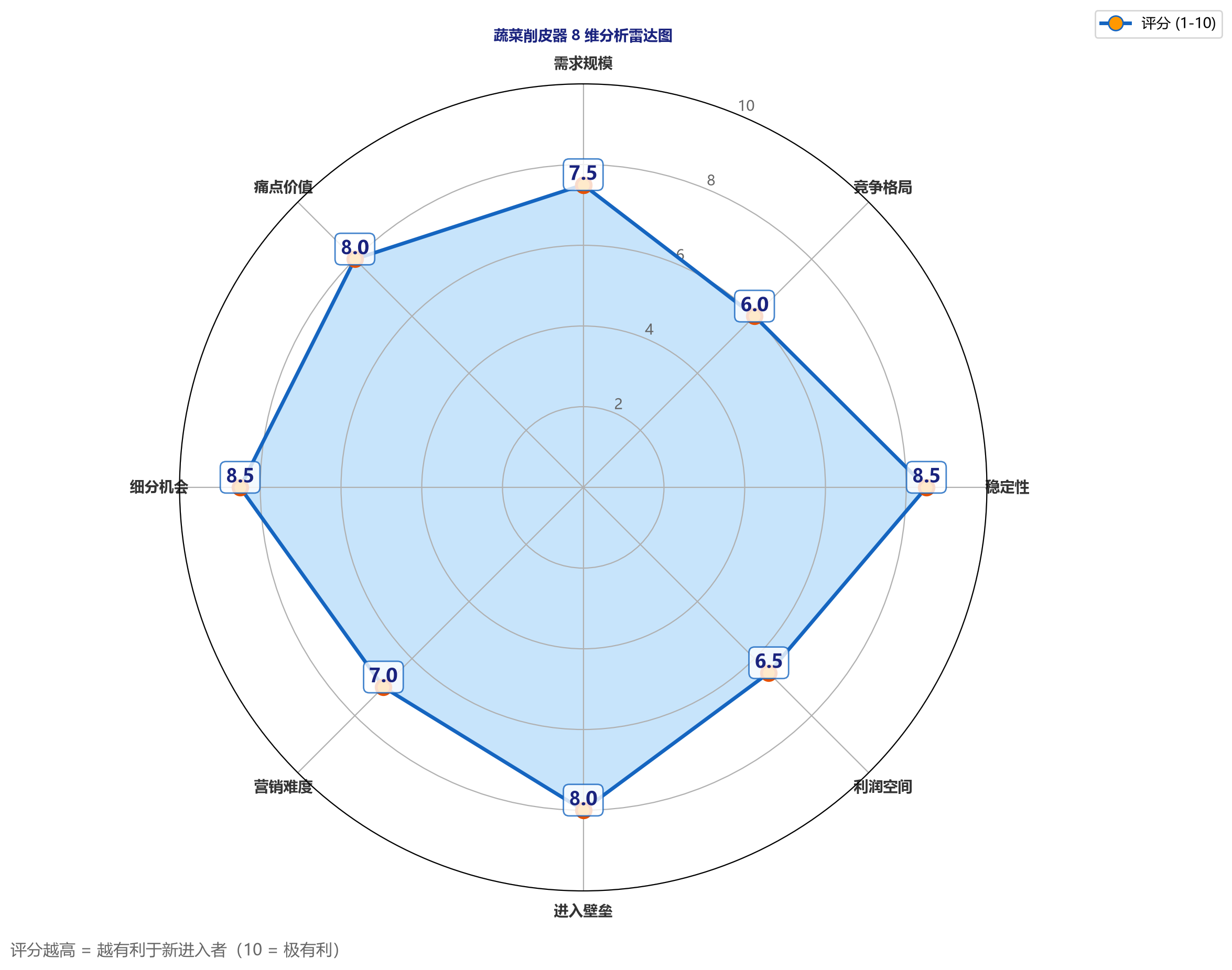
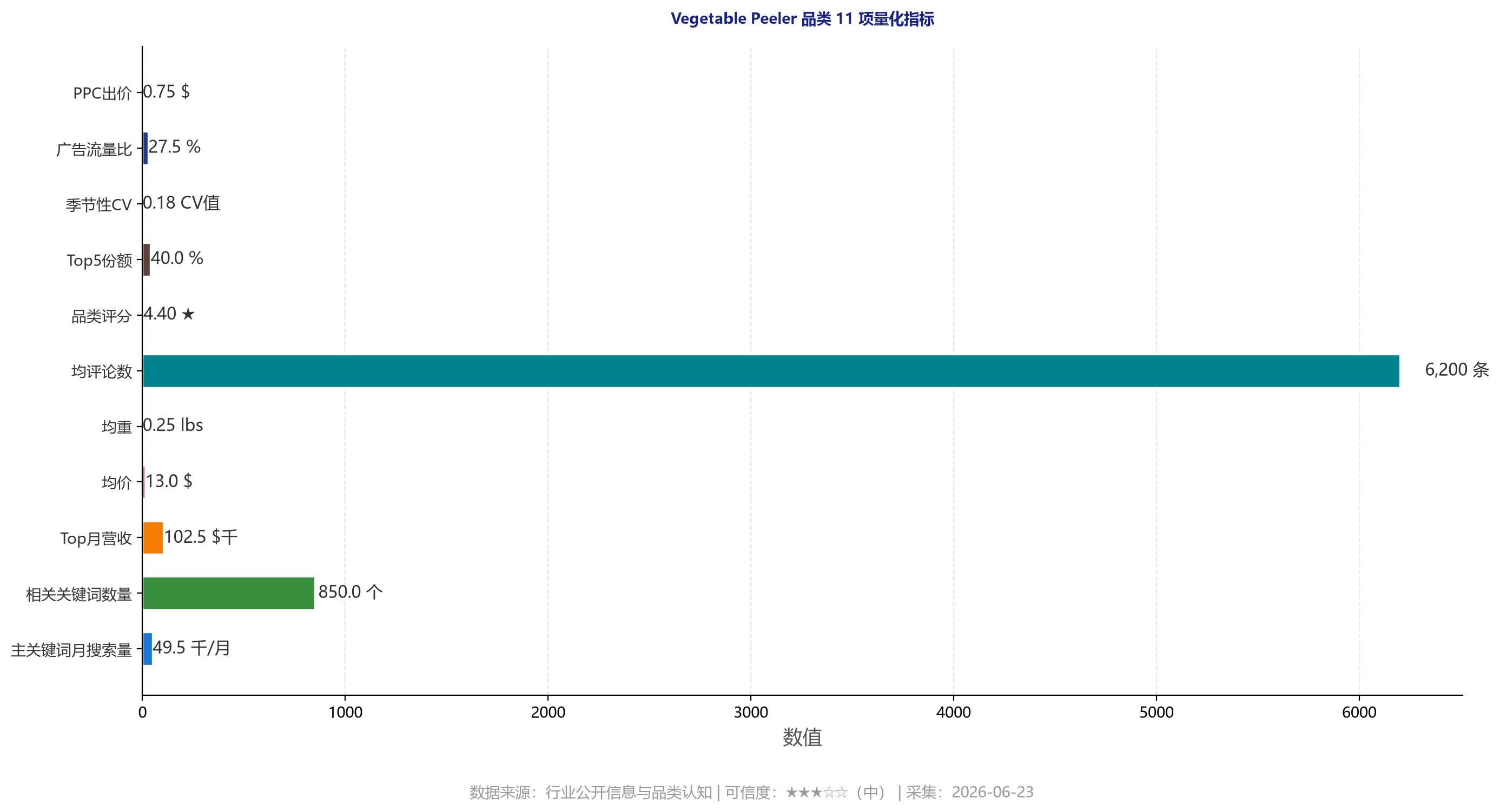
Here's the key: how to read this report
The table below is the skill's core standard — memorize it and you can use it yourself:
"Amazon Market Deep-Dive" built-in quantified standards (core dimensions)
| Metric | Good ✅ | Mid ⚠️ | Bad ❌ |
|---|---|---|---|
| Monthly search | >10K (big) | 5K-10K (mid) | <5K (small) |
| Top seller monthly revenue | >$100K | $50K-100K | <$50K |
| Effective competitors | <50 (low) | 50-200 (mid) | >200 (high) |
| Top5 market share | <40% (fragmented) | 40-60% (mid) | >60% (monopoly) |
| Top10 avg reviews | <500 (opportunity) | 500-1000 (mid) | >1000 (high barrier) |
| PPC CPC | <$1 (cheap) | $1-2 (mid) | >$2 (expensive) |
| Seasonality CV | ≤0.5 (non-seasonal) | — | >0.5 (seasonal) |
| YoY growth | >+10% (growing) | -5%~+10% (stable) | <-5% (declining) |
| DDP as % of price | <30% (good profit) | 30-40% | >40% (risky) |
| MOQ inventory risk | <500 (low) | 500-2000 (mid) | >2000 (high) |
Mapping the peeler report data onto this table:
Overall verdict6 ✅ + 2 ⚠️ + 0 ❌
The Amazon US peeler market is viable, but there's an iron rule: don't do general styles, you must go niche.
2 key judgments:
① General styles are a dead end — the "vegetable peeler" main keyword is locked down by OXO (35K reviews) and Kuhn Rikon; a beginner muscling in with pure ads = burning cash to die. But the overall market is healthy, capital barrier is low, year-round essential.
② The opportunity is in niche blue oceans — citrus peeler, shrimp deveiner, corn peeler: these niches have low Top5 share and near-zero review barriers, the openings a beginner can enter. That's exactly what the next post digs into.
Dual-mode fit: Premium FBA 7/10 (recommended) · Dropship 3/10 (not recommended, the $5-10 white-label segment is a no-margin price war)
Same verdict, totally different moves for two seller types
Turn "general-style red ocean" into the logic for going niche
Verdict: this market is worth greenlighting. Enter a niche blue ocean like citrus peeler / shrimp deveiner, avoiding the general-style review barrier. Low capital barrier (mold cost <$1000); use differentiation (high-carbon blade + anti-slip handle + anti-rust) to hit the mid-tier, targeting ≥40% margin.
Next action: after the market → go to Step 2 "find a niche" → dig deeper within the blue ocean
Why peelers don't suit dropship
Verdict: peelers don't suit dropship listing. The $5-10 white-label general styles are a price-war dead zone — after international postage and commission there's almost no margin (real margin ~25% including return losses). And peelers' core negatives (dull blade/rust) are quality issues; dropship can't change the product, only take the hits.
Suggestion: if you insist on dropship, only pick models rated 4.5+ whose details clearly state high-carbon + 304 steel, as a long-tail supplement, not a main product
Zhe's pitfall notes
The 4 market-judgment pits beginners step in most
- Charging in just because the main keyword's search is big: vegetable peeler's 49.5K is a big market, but Top5 is locked by OXO with a 35K review barrier; a beginner charging the general style is just donating money. You must read all 8 dimensions, especially finishing the competition dimension before deciding.
- Treating peelers as "too low-value to do": the $10-15 AOV isn't high, but peelers have low mold cost (<$1000), no mandatory cert, year-round essential — a low capital barrier actually suits a beginner's start. The key is using niche + differentiation to avoid the price war, not dismissing it for being cheap.
- Ignoring the "general vs niche" fundamental difference: same peeler, general-style competition 85/100 vs niche (citrus) 15/100 — over 5x apart. 80% of selection success is in "picking the right niche" — the next post covers it specifically.
- Pricing without looking at DDP: many beginners compute "price - 1688 cost = profit," forgetting FBA's 15% commission + inbound + storage + ads. The differentiated peeler's DDP is ~27% of price including everything (still healthy), but a general style gets crushed once price-warred.
Market judged — next, go find a niche
FAQ about the "Amazon Market Deep-Dive"
🤖 Run your full Amazon peeler workflow with EasyClaw
Research → sourcing → listing → promotion → operations, each stage has its own skill.
Install once, ask across the whole chain.