Can you make money selling peelers on Amazon? I ran a dual-mode margin calculation with the Amazon Market Deep-Dive
The 4-step research reaches here: the market is judged viable, the citrus peeler niche is locked, and the high-carbon-blade + anti-slip-handle differentiation is found. The final gate: can this peeler actually make money?
This step isn't guesswork — you must break out every cost. Counting only the 1688 product cost is the beginner's most common mistake. After adding FBA commission, inbound, storage, ads, and return losses, many seemingly profitable products are actually losing money. Peelers are especially telling: low product value means logistics and commission take a proportionally bigger bite.
What problem does this step actually solve
Margin math looks like accounting, but it really answers 3 decision questions:
- ① At the current price and current 1688 quote, does the overall margin meet the bar? (Premium FBA ≥40% / Dropship ≥15%)
- ② If not, which cost has the most room to compress? (negotiate product cost / raise price / cut ad ACoS)
- ③ If it really can't be compressed, abandon or switch modes?
Why I stopped doing the math in Excel by hand
I used to manage all SKU margin math in one Excel sheet, manually filling 5 tables per product: 1688 cost, sea freight quote, FBA commission, storage rate table, competitor CPC… 30 minutes per product, and missing any item → only discovering the loss in real operation.
❌ Excel by hand
· 5 tables filled by hand, 30 min per product
· Missing storage fees, ad ACoS is the norm
· Return losses estimated by gut
· Easy to underestimate logistics share for low-value products
· After the math, no "judgment standard" — don't know if the margin is high or low
✅ Using EasyClaw's "Amazon Market Deep-Dive"
· Uses product_database API to auto-pull competitor pricing + top sellers' DDP
· Auto-grades against built-in standards (Premium FBA ≥40% / Dropship ≥15%)
· Peak storage fees, ad ACoS auto-applied at industry benchmarks
· Computes both modes at once, compares which makes more
· Full margin math for a candidate in 5-8 minutes
Why I use EasyClaw instead of the SellerAmp calculator
SellerAmp / FBA revenue calculators are common cost tools. But they and EasyClaw aren't doing the same thing:
🧮 SellerAmp / FBA calculator
A pure calculator: you must fill in all the data
→ the formula is fine, but it doesn't tell you if the computed margin is good or bad
A beginner's pain:
· Computes 25% margin, doesn't know if that's high or low
· Doesn't know Premium FBA should be ≥40%, Dropship ≥15%
· Doesn't know which cost can be cut, and by how much
→ It's a calculator, not a decision tool
🤖 EasyClaw "Amazon Market Deep-Dive" (with judgment standards)
The "Amazon Market Deep-Dive" auto-pulls competitor pricing / CPC / top sellers' DDP from the JS API:
· No manual filling — the skill auto-grabs real market data
· After computing, auto-grades against built-in standards (DDP <30% ✅ / 30-40% ⚠️ / >40% ❌)
· Gives both-mode margins at once (Premium FBA / Dropship)
· When below bar, tells you "negotiate cost / raise price / abandon" directly
It's a decision tool with "judgment standards," not just a calculator.
Here's how I had EasyClaw do this
📦 "Amazon Market Deep-Dive"
Same skill as "market check" and "find a niche." This step mainly uses its product_database API (pull competitor pricing/DDP) + built-in DDP quantified standards; product cost is supplemented with "1688 Product Find."
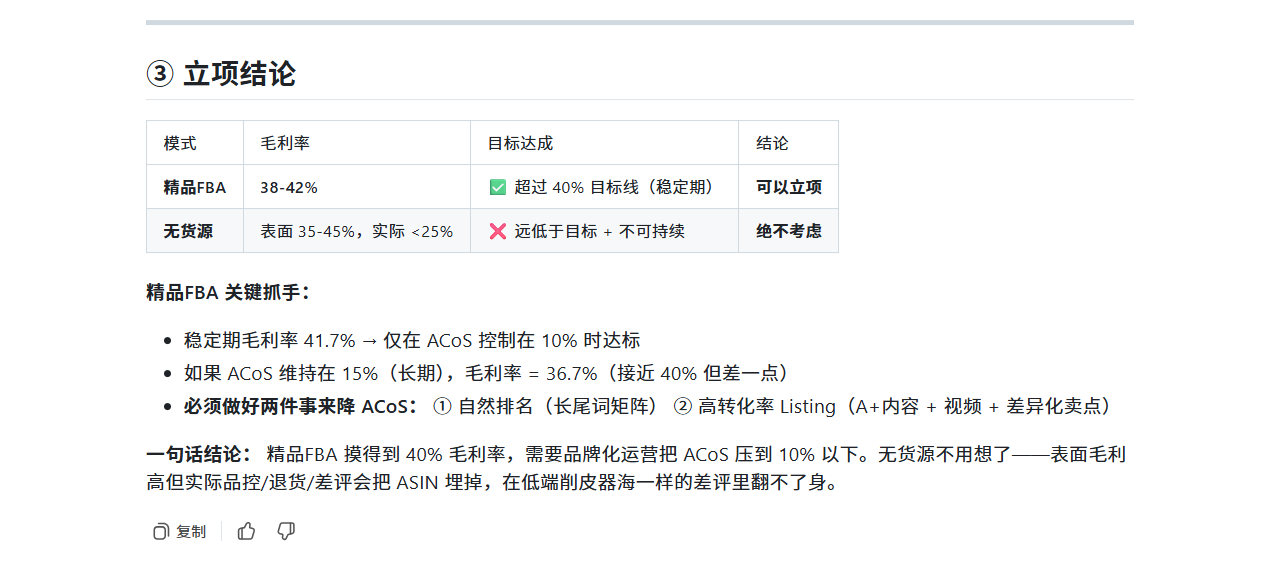
Product params:
· Price $14.99, 1688 differentiated quote ¥7.6 (~$1.05, high-carbon blade + TPR soft handle + 304 head)
· Custom box +$0.15, net weight ~85g, MOQ 2000
Compute both 🟠 Premium FBA mode (incl. inbound + intake + commission + FBA fulfillment + storage + ad ACoS) and 🔵 Dropship mode (incl. international postage + platform commission + return losses) overall margins.
Grade against built-in standards (Premium FBA ≥40% / Dropship ≥15%)."
EasyClaw auto-runs the product_database API to pull competitor pricing/DDP industry benchmarks and computes each mode separately.
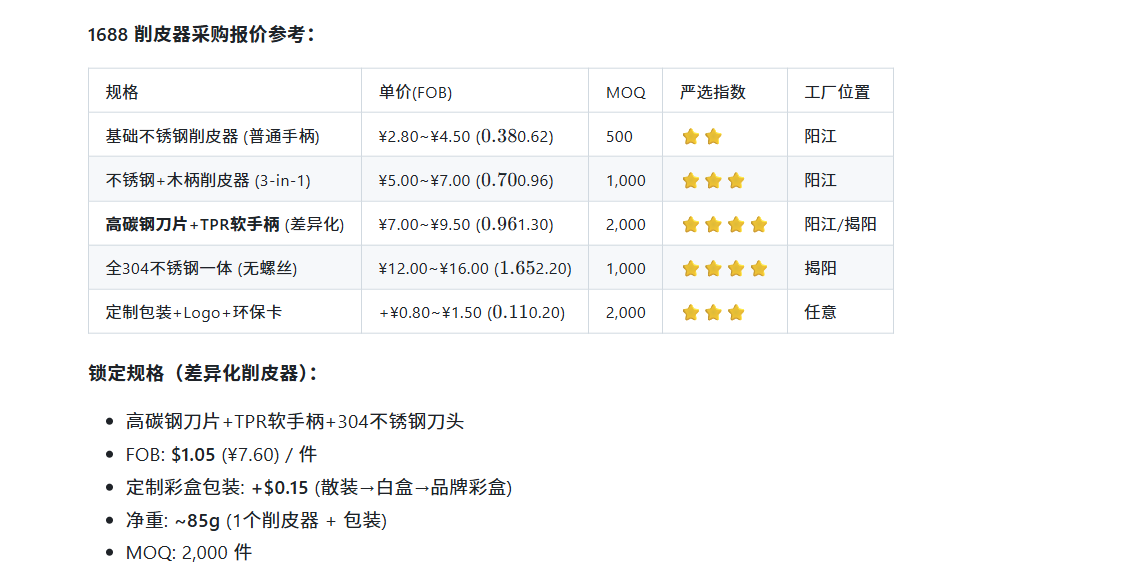
The dual-mode margin comparison the skill produced
EasyClaw outputs the dual-mode margin math (based on real C1 1688 cost $1.05 + competitor pricing $14.99):
Private mold + stocking + FBA warehouse + Prime traffic
| Item | Amount | % of price |
|---|---|---|
| Price | $14.99 | 100% |
| 1688 cost (incl. box) | -$1.20 | 8.0% |
| Inbound sea freight + duty | -$0.36 | 2.4% |
| Amazon commission (15%) | -$2.25 | 15.0% |
| FBA fulfillment + storage | -$3.43 | 22.9% |
| Ad ACoS (stable 10%) | -$1.50 | 10.0% |
| DDP total cost | -$8.74 | 58.3% |
| Overall margin (stable) | $6.25 | 41.7% ✅ |
✅ At stable ACoS 10%, margin 41.7%, above the 40% bar → greenlight (at launch-phase ACoS 15% it's 36.7%, close to bar)
1688 drop-ship + international postage + zero inventory
| Item | Amount | % of price |
|---|---|---|
| Price | $14.99 | 100% |
| 1688 cost (incl. packaging) | -$1.20 | 8.0% |
| Intl logistics (sea+duty) | -$0.36 | 2.4% |
| Transit margin | -$0.50 | 3.3% |
| Platform commission (15%) | -$2.25 | 15.0% |
| Return / conversion loss | -$1.45 | 9.7% |
| Actual total cost | -$11.24 | 75.0% |
| Actual overall margin | $3.75 | 25.0% 🔴 |
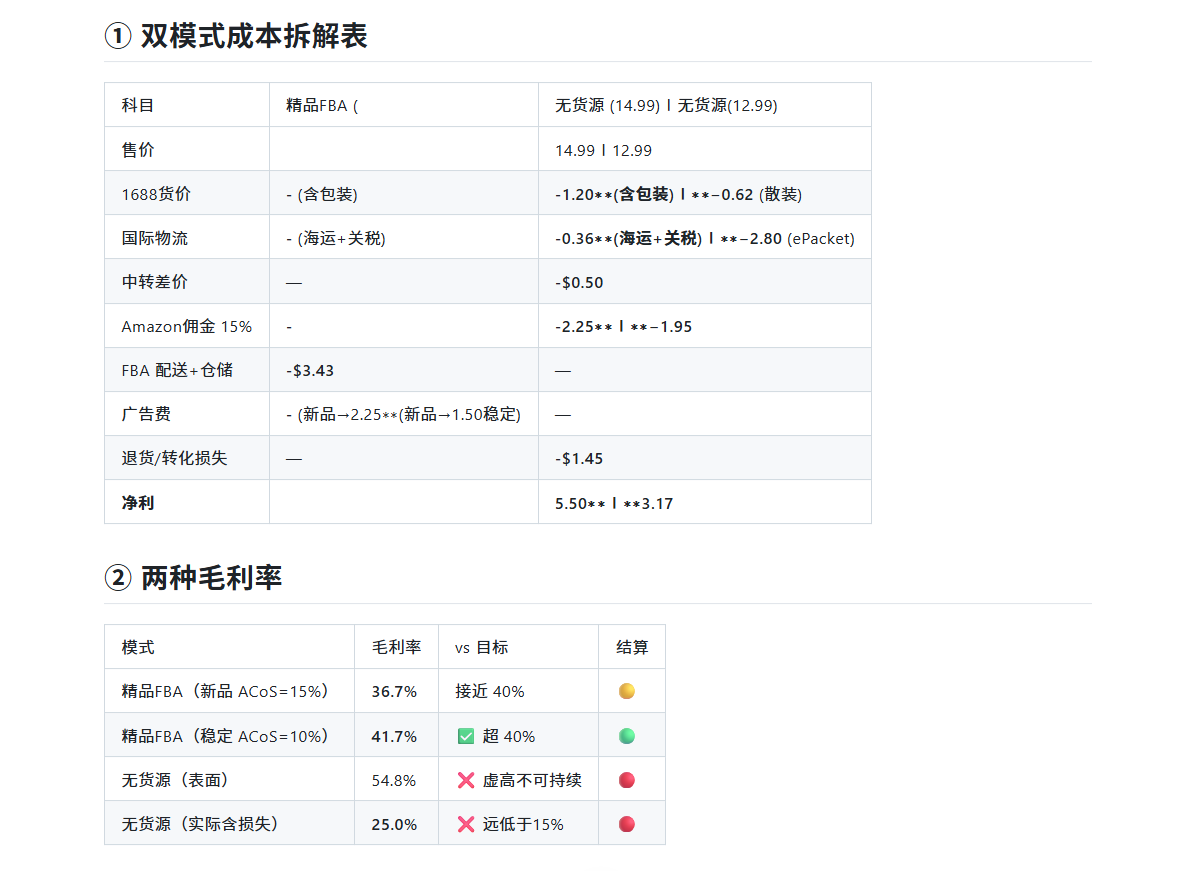
🔴 The surface 54.8% is inflated; after return/conversion losses it's only 25% → peelers are quality-sensitive, dropship is uncontrollable, not recommended
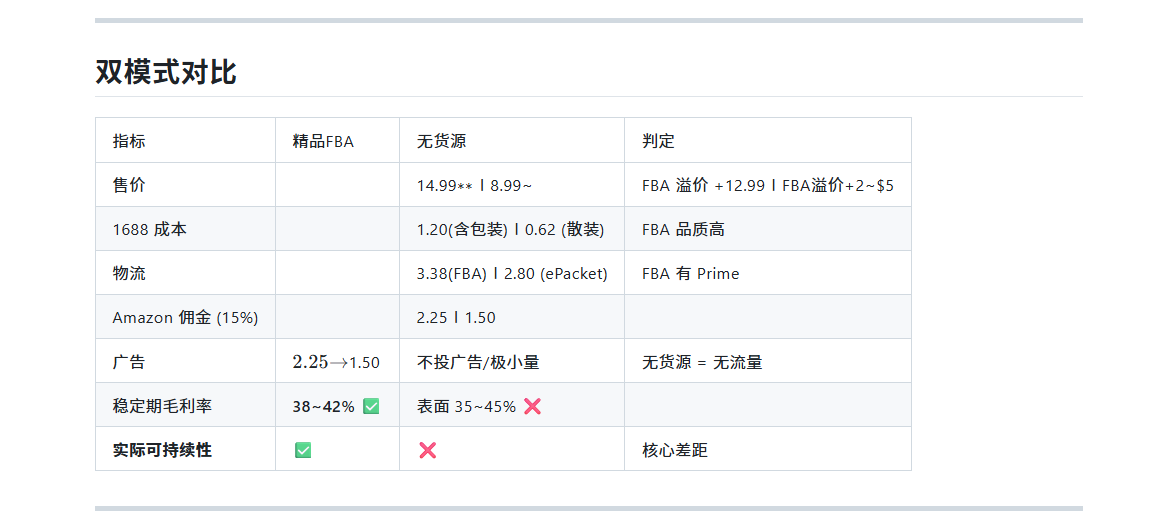
Here's the key: how to read "the decision" from this margin math
Dropship's "surface margin" is a trap — count the real losses
The dropship peeler's surface margin 54.8% looks tempting, but after return/conversion losses it's only 25%. Peelers are quality-sensitive — dull-blade and rust negatives can't be fixed by dropship, only absorbed. Once the return rate rises, the profit is eaten. Surface margin must always subtract return losses to be real.
Ad ACoS is the biggest variable — compute at stable phase
Premium FBA's launch-phase ACoS 15% gives 36.7% margin (close to bar); stable-phase ACoS compressed to 10% gives 41.7% (passes). Always compute at "stable-phase target ACoS," not launch estimates. The beginner's most common mistake: computing with high launch-phase ACoS, concluding "no profit," and abandoning early — when it recovers once it ramps.
For low-value products, FBA fulfillment share is the key
Peelers are low-value ($14.99), and FBA fulfillment+storage at $3.43 takes 22.9% — a common flaw of low-value small items. So peelers must control volume and weight (net weight 85g is an advantage), landing in the FBA small-item standard-size fee tier to keep fulfillment fees down. Once volume exceeds the limit, fulfillment fees double and margin drops to zero.
Stacking the three signals, the margin-math decision is clear:
Overall decisionPremium FBA greenlight
🟠 Premium FBA margin 41.7% (stable) ≥ 40%: passes, greenlight. The keys are controlling net weight to 85g for the small-item tier + compressing ACoS to 10% at the stable phase.
🔵 Dropship actual margin 25%: the surface 54.8% is inflated. Although it's numerically >15%, peelers are quality-sensitive, dropship can't control blade/anti-rust quality, and negative/return risk is high — not recommended as a main product.
Final decision: go Premium FBA, build a differentiated private mold. Use the three differentiation points — high-carbon blade + TPR handle + 304 anti-rust — to support the $14.99 price, control net weight for the small-item tier, and reach 41.7% margin at the stable phase.
Same math, totally different paths for two seller types
Margin passes, enter sourcing + sampling
41.7% margin passes → greenlight. Next, find a factory in Yangjiang/Jieyang, sample 3-5 versions per the differentiation plan (high-carbon blade HRC54-58 + TPR soft handle + 304 head), test sharpness retention over 100 potato peels + rust over 50 dishwasher cycles, then finalize a branded private mold.
Next action: greenlight → sourcing supply chain (Yangjiang factory sampling) → QC finalize
Quality uncontrollable, not for a main product
Actual margin 25% passes the 15% line, but peelers' core negatives (dull blade/rust) are quality issues dropship can't fix. If you insist, only pick models rated 4.5+ whose details clearly state high-carbon + 304 steel, as a long-tail supplement — don't commit big inventory.
Suggestion: peelers should go Premium FBA first, dropship only as a test supplement
Zhe's pitfall notes
The 5 margin-math pits beginners step in most
- Don't be fooled by dropship's "surface margin": 54.8% looks higher than FBA's 41.7%, but after return/conversion losses it's only 25%. Peelers are quality-sensitive with high dropship return rates — the surface number is meaningless.
- Always compute at stable-phase ACoS, not launch estimates: FBA's launch-phase ACoS 15% gives 36.7%, dropping to 10% at the stable phase passes at 41.7%. Do the math for the long run, don't get scared off by startup-phase data.
- For low-value products, obsess over volume and weight: peelers are low-value, and FBA fulfillment is 22.9% — the big chunk. Keeping net weight ~85g and going small-item standard-size is the lifeline for a peeler to make money. Exceed the size and fulfillment fees double — straight loss.
- The 1688 quote is the "non-promo price" — remember to negotiate: the differentiated model's ¥7.6 is the MOQ-2000 quote; at higher volume (5000+) it can drop another 10-15%. Higher MOQ = lower unit price, but higher inventory risk — balance it.
- Differentiation is the lever to lift margin: precisely because of the three real differentiators (high-carbon blade + anti-slip handle + anti-rust), the $14.99 price holds (nearly double the $8 white-label). Without differentiation you can only price-war, and margin goes to zero.
Margin math done — the product research is fully complete
FAQ about margin math
🤖 Run your full Amazon peeler workflow with EasyClaw
Research → sourcing → listing → promotion → operations, each stage has its own skill.
Install once, ask across the whole chain.