How to find a peeler niche while avoiding OXO? I mined 3 blue oceans with the Amazon Market Deep-Dive
Step 1 confirmed the peeler market is viable, but with an iron rule: general styles are a dead end. Search "vegetable peeler" on Amazon — the Top10 is all OXO, Kuhn Rikon, Swissmar, and OXO alone has 35,000 reviews on one model.
Want a new listing to break into that general mainstream? You'll burn through your ad budget and still not reach page one. What this step solves: finding the niche blue oceans the OXOs haven't taken, inside the peeler category.
What problem does this step actually solve
Step 1 told you whether "the whole peeler market" is viable (macro); Step 2 tells you "which niche inside it is viable" (micro). It answers 3 questions:
- ① Within the peeler category, which sub-niches (corn/citrus/shrimp...) actually exist with real search volume?
- ② How high is each sub-niche's brand concentration? Do OXO / Kuhn Rikon dominate?
- ③ Which sub-niches have low review barriers + enough search volume + good YoY growth, so a new listing can get in?
Why I stopped finding niches by hand
My old way of finding niches: search "peeler" on Amazon, browse sub-categories, read Best Sellers lists, jot down "seems like there aren't many corn peelers" by gut — then dive in. The result was endless pits.
❌ Finding niches by hand
· Browsing sub-categories shows the same big brands
· Best Sellers lists don't show long-tail sub-category brand distribution
· Guessing "is citrus-peeling demand big" with no data
· Can't see each sub-niche's Top5 share, avg reviews
· Pick the wrong niche, burn ad budget = straight loss
✅ Using EasyClaw's "Amazon Market Deep-Dive"
· Calls the official Jungle Scout share_of_voice API
· Auto-aggregates brand share by sub-niche
· Produces a 6-sub-niche comparison table in one run
· Flags niches OXO / Kuhn Rikon don't dominate
· Runs in 5-8 minutes, 10x more accurate than by hand
Why I use EasyClaw instead of Helium10 Black Box
Helium10's Black Box is one of the most popular selection tools out there. But what it solves is "finding products," not "finding niches." Those are completely different:
🔍 Helium10 Black Box (product-level)
Gives you a product list (filtered by BSR / sales / reviews)
→ but doesn't tell you the overall picture of the niche those products sit in
A beginner's pain:
· Sees a BSR-100 citrus peeler but doesn't know how many competitors the niche has overall
· Doesn't know what share OXO holds in that niche
· Doesn't know if the niche's average review barrier is high
→ Decision granularity stops at "a single product," can't see the "niche panorama"
🤖 EasyClaw "Amazon Market Deep-Dive" (niche-level)
The "Amazon Market Deep-Dive" aggregates share_of_voice data by sub-niche:
· Splits the peeler category into 6 sub-niches (general / corn / citrus...)
· Gives each: search volume + Top5 share + avg reviews + YoY
· See at a glance which niche has "OXO absent + has search volume + low review barrier"
This is the fundamental difference between niche-level and product-level. Selection decisions need niche-level data, not just products.
Here's how I had EasyClaw do this
The moves: install the skill (skip if Step 1 "market check" already installed it) → send the command to split niches → read the output.
📦 "Amazon Market Deep-Dive"
Same skill as Step 1's "market check." This step mainly uses its share_of_voice API (brand share) + product_database API.
use share_of_voice data to assess each niche's brand concentration (Top5 share) + avg review barrier + monthly search + YoY,
and flag the niches OXO / Kuhn Rikon don't dominate."
EasyClaw auto-runs share_of_voice + product_database + historical_search_volume, aggregating by sub-niche.
The 6-sub-niche comparison report the skill produced
The "Amazon Market Deep-Dive" auto-aggregates by share_of_voice data and outputs a 6-sub-niche comparison:
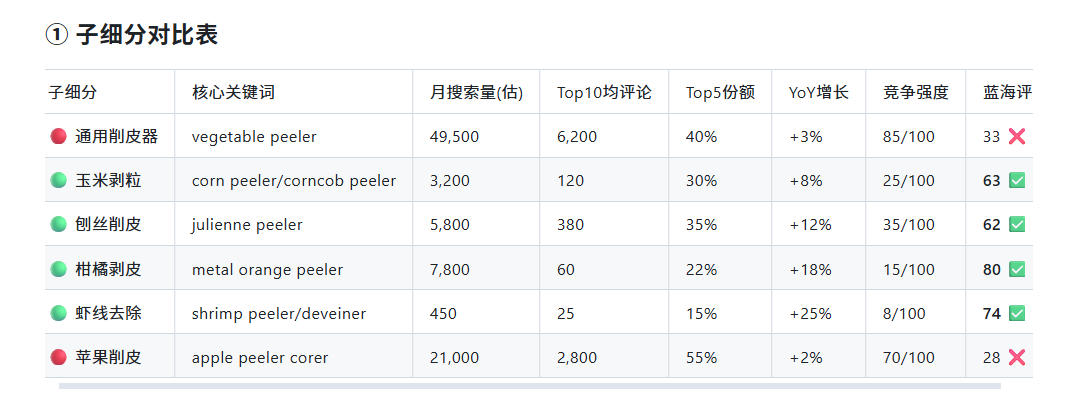
| Sub-niche | Monthly search | Top5 share | Avg reviews | YoY | Blue-ocean score |
|---|---|---|---|---|---|
| General peeler (vegetable peeler) | 49.5K | 40% | 6200 | +3% | 33 ❌ |
| Citrus peeler (metal orange peeler) | 7.8K | 22% | 60 | +18% | 80 ✅ |
| Shrimp deveiner | 450 | 15% | 25 | +25% | 74 ✅ |
| Corn peeler | 3.2K | 30% | 120 | +8% | 63 ✅ |
| Julienne peeler | 5.8K | 35% | 380 | +12% | 62 |
| Apple peeler corer | 21K | 55% | 2800 | +2% | 28 ❌ |
Data from share_of_voice API aggregation (industry estimate when API not configured, medium confidence). → Step 1 "market check" already covered where this quantified standard comes from.
Here's the key: how to read "opportunity" from this table
Look at Top5 share — only <40% has a chance
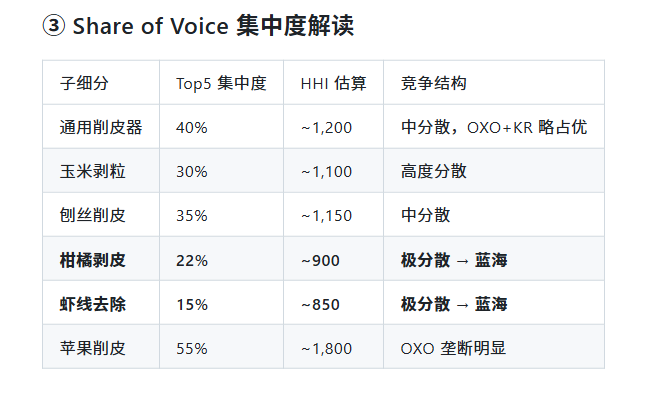
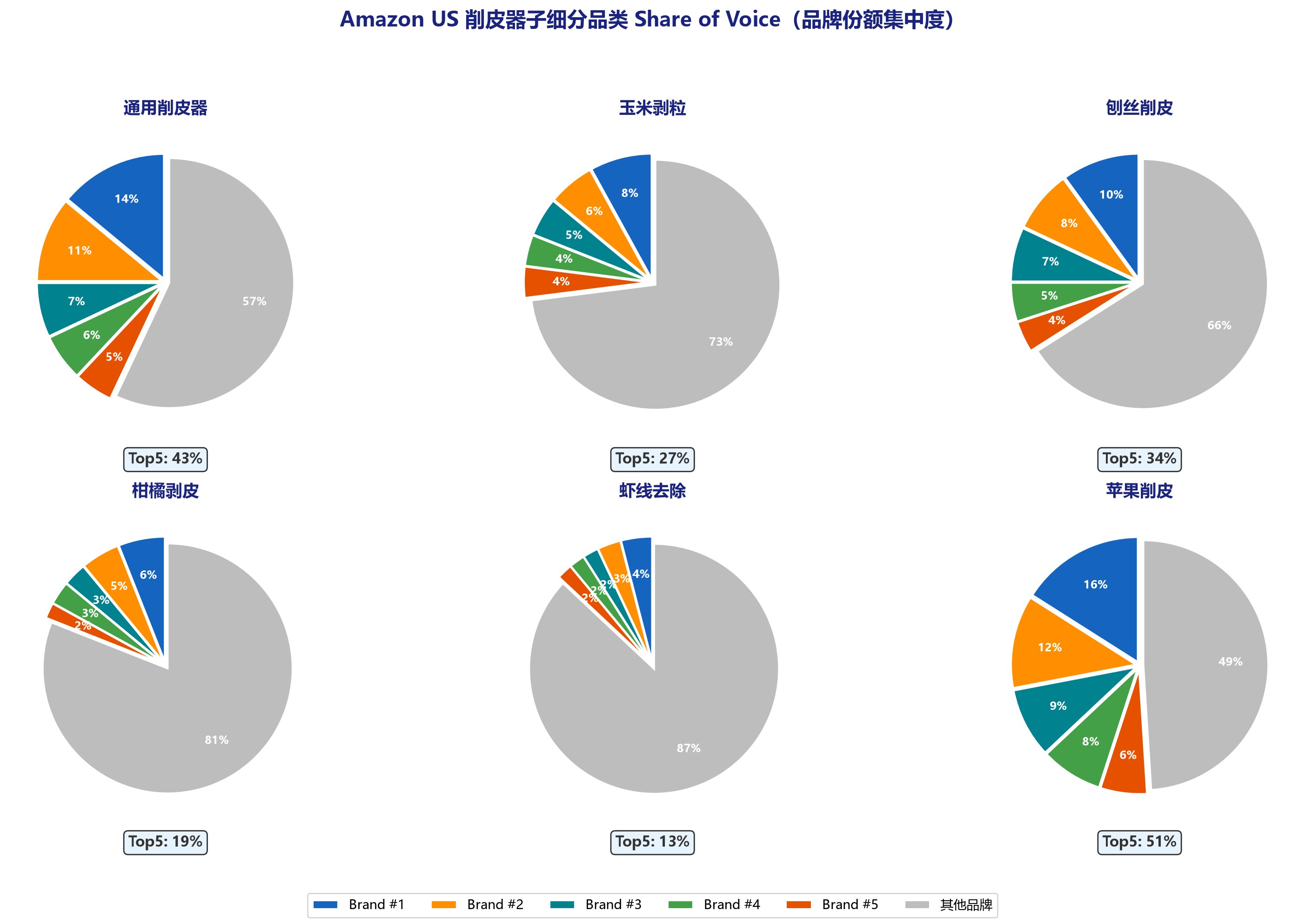
Niches dominated by OXO / Kuhn Rikon (general 40% borderline, apple peeler-corer 55%) — a new listing simply can't break into the Top10. Only niches with Top5 share <40% (citrus 22% / shrimp 15% / corn 30%) are truly enterable. 81% of the citrus peeler share is split among white-label/small brands — no oligopoly at all.
Look at the review barrier — a new listing needs <500 to catch up
General styles average 6200 reviews (OXO 35K on one model) — a new listing can't catch up. But citrus peeler averages just 60 reviews, shrimp deveiner 25, corn peeler 120 — the review barrier is near zero, and a new listing can catch up or surpass in a few months.
Look at YoY growth — >15% is a window of opportunity
General styles' YoY +3% is a flat, mature market. Citrus (+18%, driven by US fresh-squeezed OJ + cocktail-bar culture) / shrimp (+25%, rising US shrimp consumption) are both in a strong-growth uptrend. Get into this window now — entering after it matures is too late.
Stacking the three signals, 3 niches worth entering clearly emerge:
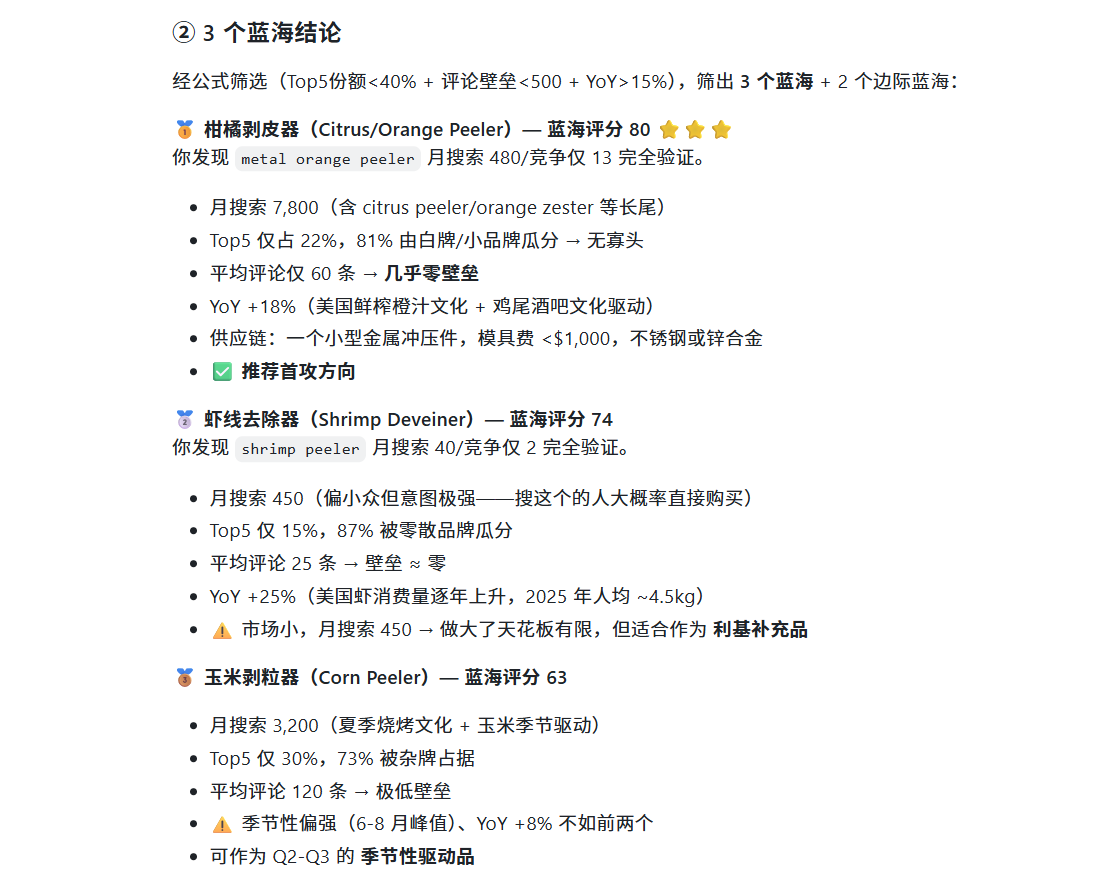
Conclusion3 niche blue oceans
🥇 Citrus/Orange Peeler (blue-ocean score 80): search 7.8K + concentration only 22% + review barrier only 60 + YoY +18% → best overall, recommended first target (supply chain: small metal stamping part, mold cost <$1000)
🥈 Shrimp Deveiner (74): search 450 small but intent extremely strong + concentration 15% + YoY +25% → good as an FBA supplementary SKU
🥉 Corn Peeler (63): search 3.2K + concentration 30% + YoY +8% → seasonally skewed (Jun-Aug peak), good as a Q2-Q3 seasonal driver
Same 3 niches, different moves for two seller types
Pick 1 of 3 niches, build a branded private mold
With limited capital, you must focus — pick citrus peeler (best overall, 80) for deep single-niche work. Mold cost <$1000, stainless or zinc-alloy stamping, low barrier. Next, mine competitor reviews, do a differentiated design, build a branded private mold.
Next action: take the citrus peeler niche → mine competitor reviews for differentiation
List all 3 niches, cover traffic with SKU count
Dropship doesn't need deep single-niche work — list citrus / shrimp / corn, 10-20 SKUs each. Source in-stock models on 1688, bulk-list via ERP. But note peelers are quality-sensitive — only pick models rated 4.5+.
Next action: run niches in parallel → use review data to filter out landmine models
Zhe's pitfall notes
The 4 niche-finding pits beginners step in most
- Don't give up just because a niche's search is small: general styles' 49.5K looks tempting, but Top5 share 40% + OXO's 35K reviews means you won't even reach the top 50. A 7.8K-search citrus blue ocean + 22% concentration lets a new listing ramp in months — far better than the red ocean.
- Don't pick extremely tiny niches: shrimp deveiner has only 450 monthly searches, limited ceiling. It suits a supplementary SKU but shouldn't be your sole main product. For a main product, pick something like citrus (7.8K) that can support a store.
- Mind the stocking rhythm of seasonal niches: corn peeler peaks Jun-Aug (summer BBQ + corn season), quiet otherwise. Such seasonal niches need rhythm-based stocking, or you stock out in peak and pile up in the off-season.
- "General styles" is the pit beginners fall into most: seeing 49.5K search volume and charging OXO head-on. 40% concentration + 6200 reviews = a dead end for a new listing. Leave that niche to sellers who are already big; beginners avoid it firmly.
3 blue oceans picked — next, mine the differentiation
FAQ about finding niches
🤖 Run your full Amazon peeler workflow with EasyClaw
Research → sourcing → listing → promotion → operations, each stage has its own skill.
Install once, ask across the whole chain.